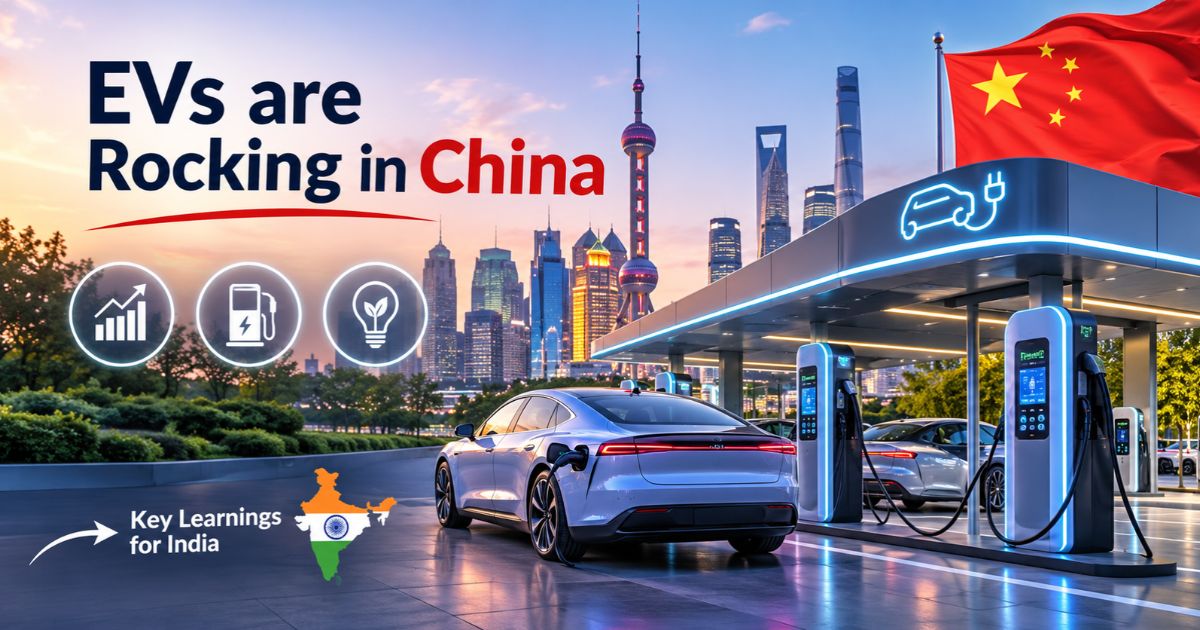
Imagine driving an electric car across a major Chinese city. You approach a charging hub, locate an available charging point through an app, connect your vehicle and begin charging. While your car receives power, you can visit a convenience store, enjoy refreshments, use clean washrooms or simply relax. Some advanced charging facilities can even deliver a substantial battery recharge in just a few minutes, provided the vehicle supports the technology.
This is not simply a vision of future transportation. It is becoming a reality in China's rapidly developing electric vehicle ecosystem.
China has emerged as one of the world's most influential electric vehicle (EV) markets. Its growth is supported by competitive vehicle manufacturing, battery technology, large-scale charging infrastructure, digital services and significant investments in electric mobility.
But one important factor deserves particular attention: China is not just selling more electric vehicles; it is building an ecosystem that makes owning and using them increasingly convenient.
This offers an important opportunity for India.
India's electric mobility market is growing, with increasing interest from vehicle manufacturers, charging operators, fleet companies, entrepreneurs and consumers. However, charging accessibility, reliability, affordability and customer experience remain important challenges.
What exactly is China doing differently? How do its modern EV charging hubs work? Which technologies are shaping the future? And what practical lessons can India adopt?
Let's explore China's EV transformation and identify the best practices that can help India develop a more reliable, accessible and customer-friendly electric mobility ecosystem.
1. China's Electric Vehicle Revolution: Understanding the Market Growth
China's electric vehicle industry has developed through years of investment in manufacturing, battery production, technology, infrastructure and government support.
Today, the country is a major global centre for electric vehicle production and consumption.
According to the International Energy Agency's Global EV Outlook 2026, more than 13 million electric cars were sold in China during 2025. Electric cars accounted for close to 55% of new car sales, making China the world's largest electric car market.
China also accounted for approximately six out of every ten electric cars sold globally in 2025.
These figures demonstrate how quickly electric mobility has moved from an emerging automotive category towards a mainstream transportation option.
Key Factors Behind China's EV Growth
Several developments have contributed to China's position.
1. Strong domestic manufacturing ecosystem
China has developed an extensive automotive manufacturing network covering:
Electric vehicle manufacturers.
Battery manufacturers.
Charging equipment suppliers.
Semiconductor and electronics companies.
Battery materials and component suppliers.
Software and automotive technology companies.
This integrated manufacturing ecosystem supports production at scale and encourages innovation.
2. Competitive electric vehicle pricing
A wide selection of electric vehicles across different price segments has made EV ownership accessible to more consumers.
Manufacturers compete through battery efficiency, vehicle range, design, technology, comfort and pricing.
According to the IEA, electric cars in China became increasingly price-competitive with conventional vehicles during 2025, particularly in smaller-car and SUV segments.
3. Continuous technological innovation
Chinese manufacturers are investing in:
Advanced battery chemistry.
Fast-charging systems.
Smart vehicle software.
Intelligent driving assistance.
Connected vehicle technologies.
Battery management systems.
4. Large-scale charging infrastructure
China has invested heavily in both public and private charging facilities, supporting everyday urban travel as well as long-distance journeys.
5. Strong policy support
Government initiatives have encouraged electric vehicle manufacturing, infrastructure investment, research and development, and consumer adoption.
The combination of manufacturing capacity, technology, competitive products and charging convenience has helped China build a powerful EV ecosystem.
2. China's EV Charging Infrastructure: A Network Built for Scale
One of the most impressive aspects of China's electric mobility transformation is the expansion of its charging infrastructure.
A major challenge for EV owners is knowing where to charge, whether a charger will work and how long charging will take.
China is addressing these concerns through an extensive network of private and public charging facilities.
According to China's National Energy Administration, the country had approximately 23.68 million charging points by the end of July 2026.
The network included:
The figures demonstrate that China's charging ecosystem is not dependent only on public charging stations. Residential and private charging facilities also play a significant role.
What Is Driving the Expansion?
China's charging infrastructure development focuses on several areas.
Urban charging networks: Charging points are being expanded across cities, commercial areas, parking facilities and residential communities.
Highway charging infrastructure: Expressway service areas are being upgraded to support long-distance EV journeys.
Residential charging: Private charging facilities allow EV owners to charge vehicles at home whenever suitable.
Ultra-fast charging: New high-power charging systems are reducing the time required for compatible vehicles to recharge.
Rural and regional connectivity: Infrastructure expansion is also intended to improve charging access beyond major metropolitan areas.
China's three-year charging infrastructure action plan announced in October 2025 targets 28 million charging facilities and public charging capacity exceeding 300 million kilowatts by the end of 2027.
The plan emphasises coverage, operational efficiency, service quality and infrastructure development in cities, highways and rural areas.
The important lesson is that charging infrastructure must expand alongside EV adoption, rather than being treated as a separate development.
3. What Makes China's EV Charging Hubs Different?
A conventional charging point provides electricity to a vehicle.
A modern EV charging hub aims to provide a complete customer experience.
This difference is important.
In many markets, charging infrastructure is planned mainly around the installation of charging equipment. However, customers also care about accessibility, waiting time, safety, convenience, payment and the availability of basic facilities.
China's advanced charging hubs offer an interesting model for improving this experience.
A. High-Power and Ultra-Fast Charging
One of the most exciting developments is megawatt-class EV charging.
In September 2026, Shenzhen opened the Longyou Flash-Charging Flagship Demonstration Station in Longhua District.
The facility was jointly developed by Longhua Investment Holding Group and BYD.
Its infrastructure includes:
10 flash-charging posts with 20 connectors.
15 ultra-fast charging posts with 30 connectors.
Liquid-cooled charging technology.
Peak charging output of up to 1,500 kW per compatible connector.
Integrated energy storage.
According to the station's reported specifications, compatible BYD vehicles equipped with the required Blade Battery technology can charge from 10% to 70% in approximately five minutes and reach nearly 97% in nine minutes.
This is a major development in reducing the time associated with public charging.
However, these figures are vehicle- and equipment-specific. A 1,500 kW charger does not mean every EV can accept power at that rate. Actual charging speed depends on battery design, temperature, state of charge and vehicle compatibility.
B. Charging Hubs with Customer Amenities
A modern charging hub should not be treated as an isolated electricity point.
The Shenzhen demonstration station illustrates how charging can be integrated into an everyday customer stop, with a convenience store located nearby.
A customer can spend the charging period purchasing refreshments or taking a short break.
Other useful facilities that EV charging hubs can incorporate include:
Clean and accessible washrooms.
Food and beverage outlets.
Comfortable waiting areas.
Free Wi-Fi.
Seating and resting spaces.
Lighting and security.
Parking assistance.
Digital information displays.
Emergency assistance facilities.
These amenities become particularly important when customers are travelling long distances.
The business opportunity is also significant: charging operators can collaborate with restaurants, cafés, convenience stores, retail outlets and service providers.
C. Smart Charging and Energy Management
High-power charging creates an important electricity infrastructure challenge.
A charging station with multiple high-power chargers can require substantial electrical capacity.
China's advanced charging projects are exploring ways to manage this demand.
The Longyou Shenzhen demonstration station integrates energy storage with charging infrastructure.
The system can store electricity during lower-demand periods and release it during high-demand periods, helping manage the power requirement of high-speed charging.
Smart energy management can support:
Better management of electricity demand.
Reduced pressure on local distribution networks.
More efficient use of available power.
Integration with renewable energy.
Improved charging economics.
This is an important lesson for Indian charging operators, particularly when developing high-capacity stations in locations with limited grid infrastructure.
D. Digital Charging Experience
A customer-friendly charging network should make the entire process simple.
A well-designed digital charging experience can include:
Finding nearby charging stations.
Checking real-time charger availability.
Viewing connector types and charging speeds.
Checking charging prices.
Reserving a charging slot where supported.
Starting and stopping a charging session.
Making digital payments.
Viewing charging history and receipts.
Reporting technical problems.
Finding nearby amenities.
The key is to reduce the number of steps required to complete a charging session.
A driver should not have to struggle with multiple applications, unclear pricing or uncertain charger availability.
4. Advanced EV Charging Technologies Transforming China
China's EV ecosystem is developing several technologies that could influence the future of electric mobility globally.
Let's understand the most important ones.
1. Megawatt Charging Technology
Megawatt charging refers to charging systems capable of delivering power at or above one megawatt.
These systems are particularly relevant for compatible next-generation passenger vehicles and high-utilisation commercial vehicles.
Potential applications include:
The technology can significantly reduce charging time, but it requires compatible vehicles, high-capacity power electronics, thermal management and appropriate grid or energy-storage infrastructure.
For India, megawatt charging should initially be evaluated at high-demand freight corridors, logistics hubs and commercial transport facilities rather than installed everywhere.
2. Battery Swapping Technology
Battery swapping offers an alternative to conventional plug-in charging.
Instead of waiting for a vehicle battery to recharge, the depleted battery is replaced with a charged one at a compatible swapping station.
China's NIO is one of the best-known companies operating a large battery-swapping network.
In February 2026, NIO announced that it had completed 100 million battery swaps since its first station began operating in 2018.
The company reported:
More than 3,790 Power Swap Stations worldwide.
Approximately 1,020 stations along major Chinese highways.
Plans to deploy its fifth-generation Power Swap Stations during 2026.
How Battery Swapping Works
The EV owner drives into a compatible swapping station.
The vehicle is positioned for the automated process.
The depleted battery is removed.
A charged battery is installed.
The vehicle completes the swapping process and leaves.
The main advantage is reduced waiting time.
Battery swapping can be particularly relevant for commercial fleets, taxis, delivery vehicles and other high-utilisation applications.
However, it requires compatible battery designs, standardisation, battery inventory, substantial capital investment and effective battery management.
It is not a universal replacement for plug-in charging.
3. Battery Energy Storage Systems
Battery Energy Storage Systems (BESS) can store electricity and supply it when charging demand increases.
They are particularly useful at high-capacity charging locations.
For example, a charging hub can store electricity during lower-demand periods and use the stored energy when several vehicles charge simultaneously.
Potential benefits include:
Managing peak electricity demand.
Supporting high-power charging.
Improving grid flexibility.
Integrating renewable energy.
Reducing dependence on immediate grid capacity expansion.
This technology deserves serious consideration in India's highway charging network and commercial fleet infrastructure.
4. Software-Defined Electric Vehicles
The future of EVs is not only about batteries and motors.
Vehicles are increasingly becoming connected digital platforms.
Software-defined vehicles use more centralised computing and software systems to control and improve vehicle functions.
These technologies can support:
Remote software updates.
Intelligent battery management.
Connected navigation.
Advanced driver assistance.
Energy-efficient driving.
Predictive vehicle maintenance.
The IEA identifies software-defined vehicles and AI-supported automotive technologies as important developments shaping the future of electric mobility.
5. Smart and Renewable-Powered Charging
The integration of solar energy, battery storage and intelligent charging management offers another opportunity.
A charging hub can combine:
Rooftop solar panels.
Battery energy storage.
Smart electricity management.
Time-based charging tariffs.
Grid-connected charging equipment.
This can improve energy management and support cleaner charging operations, depending on the electricity mix and system design.
5. Understanding the Future of Electric Vehicles in China
China's EV industry is moving beyond the early adoption stage.
The next phase will involve competition around technology, manufacturing efficiency, customer experience, charging speed and intelligent vehicle features.
Here are five important trends to watch.
Trend 1: EVs Becoming Mainstream Transportation
Electric vehicles are becoming a normal purchase option rather than a niche technology.
According to the IEA, close to 55% of new cars sold in China during 2025 were electric.
This indicates a major change in consumer preference and automotive market structure.
Trend 2: Competition Shifting Towards Technology and Customer Experience
As more manufacturers enter the EV market, vehicle manufacturers are competing through:
Customers increasingly evaluate the overall vehicle experience rather than only its electric powertrain.
Trend 3: Growth of Electric Commercial Vehicles
Commercial transportation represents an important opportunity.
Electric buses, delivery vehicles, logistics fleets and heavy-duty vehicles can benefit from predictable routes and centralised charging arrangements.
Fleet operators can plan charging schedules according to vehicle usage, reducing unnecessary waiting time and improving operational efficiency.
Trend 4: Battery Technology Innovation
Battery technology will continue to influence EV affordability, safety, charging speed and driving range.
Important areas of development include:
Lithium iron phosphate batteries.
High-nickel battery chemistries.
Solid-state battery research.
Improved battery thermal management.
Battery recycling.
Better battery management systems.
No single battery chemistry will suit every vehicle. The future will likely involve different battery technologies for different price segments and use cases.
Trend 5: Global Expansion of Chinese EV Manufacturers
China is also expanding its influence in international EV markets.
The IEA reports that China produced nearly 75% of electric cars manufactured globally in 2025.
It also recorded more than 2.5 million electric car exports during the year.
However, international expansion brings challenges, including import duties, local manufacturing requirements, competition, regulations and supply-chain considerations.
For India, this creates an opportunity to learn from China's manufacturing and infrastructure developments while strengthening domestic automotive capabilities.
6. India’s EV Ecosystem: Progress, Opportunities and Challenges
India has made considerable progress in electric mobility.
The market includes electric two-wheelers, three-wheelers, passenger cars, buses and commercial vehicles.
Electric two-wheelers and three-wheelers are particularly important because of their relevance to urban mobility and last-mile transportation.
However, the charging experience needs further improvement.
According to a September 2026 IEEFA briefing, India's public charging network increased from approximately 5,151 stations in 2022 to 52,718 by July 2026.
The report also highlights that the next phase of development must focus on charger reliability, interoperability, affordability and easier access to charging.
Major Challenges Facing India's EV Charging Ecosystem
1. Charger reliability
A charging station may appear on an application but may not be operational when a driver reaches the location.
This creates frustration and reduces confidence in public charging infrastructure.
2. Fragmented charging applications
EV users may need multiple applications to locate charging stations, check availability and complete payments.
This creates unnecessary complexity.
3. Uneven infrastructure distribution
Charging infrastructure is often concentrated in selected urban locations, while smaller cities and highway corridors require further development.
4. High public charging costs
Public charging prices can be higher than residential charging costs, affecting the overall ownership experience.
5. Grid connectivity and power availability
Charging operators may face delays in securing electricity connections and obtaining sufficient power capacity.
6. Limited customer amenities
Some charging locations provide little more than charging equipment and parking space.
For longer charging sessions, customers need clean washrooms, seating, food options, security and other basic facilities.
7. Business viability
Charging stations require investment in land, equipment, electrical infrastructure, maintenance and software.
Without sufficient utilisation, operators may struggle to recover their investment.
The challenge for India is not simply to install more chargers. It is to make charging infrastructure reliable, commercially sustainable and convenient for customers.
7. What India Can Learn from China's EV Charging Hubs
China's experience provides several valuable lessons for India.
However, India should adapt these ideas according to its own vehicle mix, road conditions, electricity infrastructure, consumer behaviour and economic requirements.
The objective should not be to copy China's largest charging stations. It should be to create a practical charging network that works for Indian consumers.
Lesson 1: Build Customer-Friendly Charging Hubs
Indian charging stations should be designed around customer needs.
Instead of installing chargers in isolated locations, operators should explore partnerships with:
Customers should be able to use their charging time productively.
For example, a highway charging hub could include a restaurant, clean washrooms, a convenience store, seating areas and safe parking.
This also creates business opportunities for local entrepreneurs.
Lesson 2: Focus on Charger Uptime and Reliability
A smaller network of operational chargers can be more valuable than a large network with frequent breakdowns.
Charging operators should introduce:
Charger uptime should become a major performance indicator.
Lesson 3: Introduce a Unified Digital Charging Experience
India should make it easier for EV owners to locate and access charging stations.
An ideal digital charging experience should provide:
A map of available charging stations.
Real-time charger status.
Charging speed information.
Transparent electricity and service charges.
Digital payments.
Reservation options where supported.
Customer reviews and feedback.
Navigation and route planning.
Interoperability between different charging networks should also improve.
The objective should be simple: one convenient experience rather than several disconnected applications.
Lesson 4: Develop Smart Highway Charging Hubs
Highway charging infrastructure should be developed strategically.
Important locations include:
These charging hubs should support compatible passenger vehicles as well as commercial vehicles.
The charging mix should depend on traffic patterns, expected utilisation, vehicle compatibility and grid availability.
Lesson 5: Use Battery Storage and Renewable Energy
India should explore solar-powered charging hubs supported by battery storage.
This can be particularly useful in locations where electricity supply is constrained or demand varies significantly.
Charging operators should evaluate:
Rooftop solar installations.
Battery storage systems.
Intelligent energy management.
Time-of-use electricity tariffs.
Grid demand management.
Lesson 6: Encourage Battery Swapping Where It Makes Economic Sense
Battery swapping can be particularly useful for high-utilisation vehicles.
India can explore this model for:
However, common battery standards, safety requirements, interoperability and transparent ownership models are essential.
Lesson 7: Make Charging Affordable and Transparent
Customers should understand exactly what they are paying for.
Charging stations should display:
Clear pricing builds consumer confidence.
Lesson 8: Create Charging Hubs That Support Local Businesses
This is an important opportunity for India's small businesses and regional entrepreneurs.
Charging stations can become local commercial destinations.
For example, a charging hub can partner with:
This creates additional revenue opportunities beyond electricity sales.
8. A Practical EV Charging Hub Model for India
What would an ideal customer-friendly EV charging hub look like in India?
Consider a highway charging facility developed near a busy expressway or industrial corridor.
Suggested Charging Hub Infrastructure
Facility | Recommended features |
EV charging | AC and DC charging options |
Fast charging | Multiple compatible DC charging points |
Digital system | Real-time availability and digital payments |
Parking | Clearly marked and safe EV parking |
Amenities | Washrooms, seating and drinking water |
Food | Café, restaurant or convenience store |
Safety | CCTV, lighting and emergency assistance |
Energy | Solar integration and battery storage where viable |
Maintenance | Remote monitoring and technical support |
Customer support | Visible helpline and complaint resolution |
How the Customer Experience Should Work
Step 1: Discover
The driver searches for a charging station using a mobile application or navigation system.
Step 2: Compare
The driver checks charger availability, charging speed, connector compatibility and pricing.
Step 3: Navigate
The driver receives directions to the selected charging hub.
Step 4: Charge
The vehicle is connected to the appropriate charger.
Step 5: Use Amenities
The customer can access refreshments, washrooms, seating or nearby commercial services.
Step 6: Pay
The customer completes payment through a convenient digital method and receives a clear receipt.
Step 7: Continue the Journey
The driver receives charging completion information and continues travelling.
The goal is to make EV charging as predictable and convenient as possible.
9. Business Opportunities in India's Growing EV Ecosystem
The growth of electric mobility is not only an opportunity for automobile manufacturers.
It also creates opportunities for local entrepreneurs, small businesses, startups, service professionals and regional enterprises.
Here are some areas worth exploring.
1. EV Charging Station Businesses
Entrepreneurs can explore charging infrastructure opportunities at:
Commercial properties.
Shopping complexes.
Hotels.
Parking facilities.
Highway locations.
Industrial areas.
The business model should be evaluated based on local EV demand, electricity costs, land availability, grid connectivity and expected utilisation.
2. EV Maintenance and Repair Services
As the number of EVs increases, demand may grow for trained technicians and specialised maintenance services.
Potential opportunities include:
EV diagnostics.
Electrical system maintenance.
Battery health assessment.
Charging equipment maintenance.
Vehicle software diagnostics.
Tyre and general vehicle services.
High-voltage EV systems require appropriate training, tools and safety procedures.
3. EV Accessories and Components
Entrepreneurs can explore businesses involving:
Charging cables and accessories.
EV-compatible safety equipment.
Charging station components.
Vehicle accessories.
Battery management-related components.
Energy management products.
Products must meet applicable technical and safety standards.
4. EV Charging Hub Partnerships
Local businesses can partner with charging operators to provide:
Food and refreshments.
Retail services.
Vehicle cleaning.
Parking facilities.
Accommodation.
Travel assistance.
These partnerships can create additional customer traffic for existing businesses.
5. EV Technology and Software Services
Startups and technology companies can explore:
Charging management software.
Charger monitoring systems.
Fleet management applications.
Digital payment integrations.
Energy analytics.
Charging station discovery platforms.
Predictive maintenance solutions.
6. Employment and Skill Development
The expanding EV ecosystem can create demand for professionals in:
Training institutions and businesses should work together to develop practical skills relevant to these roles.
10. Government Initiatives Supporting India's EV Infrastructure
India has introduced several policies and initiatives to support electric mobility.
PM E-DRIVE Scheme
The PM Electric Drive Revolution in Innovative Vehicle Enhancement (PM E-DRIVE) scheme supports electric vehicle adoption and charging infrastructure development.
The scheme has a total outlay of ₹10,900 crore, with ₹2,000 crore allocated for public EV charging infrastructure, including charging stations and battery-swapping infrastructure.
The government has also issued operational guidelines for deploying public EV charging stations under the scheme.
Eligible government agencies, public-sector entities and state bodies can participate through the designated implementation framework.
Official resource: https://heavyindustries.gov.in/
Ministry of Power EV Charging Infrastructure Guidelines
The Ministry of Power issued the Guidelines for Installation and Operation of Electric Vehicle Charging Infrastructure in September 2024.
These guidelines provide a framework for developing accessible, safe and interoperable charging infrastructure.
Important areas include:
Public and private charging infrastructure.
Electricity connections.
Charging station operations.
Technical standards.
Land availability.
Network service providers.
Charging infrastructure accessibility.
Official resource: https://beeindia.gov.in/
State-Level EV Policies
Different Indian states have developed EV policies and incentives based on their regional priorities.
Entrepreneurs should review their respective state policies, electricity tariffs, local permissions and applicable subsidy conditions before investing in charging infrastructure.
Government incentives and scheme conditions can change, so current official guidelines should always be checked.
11. The Future of India's EV Ecosystem: What Should Happen Next?
India has an opportunity to build an EV ecosystem that is affordable, reliable, scalable and suitable for its unique transportation requirements.
The next stage should focus on five priorities.
1. Reliability over installation numbers
Charging stations must work consistently. Operational performance should be measured alongside the number of installed chargers.
2. Customer experience over technology alone
Fast charging is valuable, but easy access, transparent pricing, clean facilities and dependable service are equally important.
3. Collaboration between public and private sectors
Government agencies, charging operators, vehicle manufacturers, electricity distribution companies and local businesses should work together.
4. Stronger regional infrastructure
Smaller cities, industrial towns, tourist destinations and highway corridors should receive appropriate attention.
5. Opportunities for local entrepreneurs
Small businesses should be encouraged to participate in EV charging, maintenance, retail partnerships and technology services.
A Five-Year Outlook: 2027–2031
The following are strategic possibilities rather than guaranteed forecasts.
Area | Expected direction | Opportunity for India |
Fast charging | Wider use of high-power charging | Highway and fleet charging |
Battery technology | Improved charging and energy density | Local battery innovation |
Battery swapping | More specialised commercial applications | Two- and three-wheeler fleets |
Smart infrastructure | Connected chargers and digital management | Unified charging experience |
Renewable energy | Solar and storage integration | Sustainable charging hubs |
EV employment | Greater demand for technical capabilities | Training and skill development |
India does not need to replicate every advanced technology immediately.
It should prioritise solutions that provide measurable improvements in customer convenience, infrastructure utilisation and business sustainability.
Conclusion: China Is Building an EV Ecosystem. India Has an Opportunity to Build Its Own.
China's electric vehicle success demonstrates that vehicle manufacturing alone cannot transform transportation.
A successful EV ecosystem requires the right combination of affordable vehicles, reliable charging infrastructure, advanced battery technology, digital convenience, supportive policies and customer-focused services.
Its modern charging hubs show how the charging experience can move beyond simply supplying electricity.
Fast charging, battery swapping, integrated energy storage, digital discovery and customer amenities are creating new possibilities for electric mobility.
For India, the biggest lesson is clear: The future of electric vehicles will depend not only on how many EVs are sold, but also on how easily people can charge, maintain and use them.
India should build charging infrastructure that works for its cities, highways, commercial fleets and local communities.
It should also create opportunities for entrepreneurs, small businesses, technology companies and skilled professionals to participate in this transformation.
The electric mobility revolution is not just an automotive opportunity. It is an opportunity to develop new businesses, create employment and build smarter transportation infrastructure.
Disclaimer
This article is intended for general informational and educational purposes. EV market statistics, government policies, charging technologies, infrastructure targets and manufacturer announcements may change over time.
China's EV market statistics may use different definitions, including battery electric vehicles (BEVs), plug-in hybrid electric vehicles (PHEVs) and the broader new-energy vehicle (NEV) category. These figures should not be directly compared without considering their definitions and reporting periods.
Charging speeds depend on vehicle compatibility, battery condition, temperature, charging equipment and electrical infrastructure. Manufacturer-reported charging performance should not be interpreted as a universal charging standard.
Businesses interested in EV charging infrastructure should conduct independent feasibility studies and verify electricity tariffs, land permissions, technical standards, safety requirements and government incentives before investing.
New India Connect is a local business discovery platform. This article is educational and does not constitute investment, engineering or financial advice.
Research verification notes
The following sources support the article's major factual claims:
China's 2025 EV market and global manufacturing position: International Energy Agency.
IEA+1
China's 23.68 million charging points by July 2026 and 2027 infrastructure target: China's National Energy Administration reporting through the State Council website.
State Council of China+1
Shenzhen's 1,500 kW charging hub and charging performance: Shenzhen Government Online.
Shenzhen Municipal Government+1
NIO's battery-swapping network and 100 million swaps announcement: NIO.
NIO
India's public charging network and user-experience challenges: IEEFA's September 2026 research.
IEEFA+1
India's PM E-DRIVE infrastructure funding and guidelines: Ministry of Heavy Industries.
Press Information Bureau+1
Important distinction: China's 2025 electric-car sales share, China's NEV figures and India's all-category EV adoption figures are not identical measures. Keep the reporting periods and vehicle categories visible whenever statistics are compared.